


The Escapement is one of the most important parts of the mechanism of a watch. It may be one of either of the following.
The Verge escapement, as applied to Watches, will be seen annexed, A, part of the balance; b, the verge body; C, C, the pallets; D, the escape-wheel; E, escape-wheel pinion. The verge or arbor B of the balance has two pallets, C, C, which stand out at right angles, so as to be acted on alternately by the sloping teeth in the opposite sides of the crown or escapement-wheel, C.
The Horizontal escapement, on the following page,[ 79] so called because of the escape-wheel acting horizontally to the axis of the balance. This invention was perfected by Graham, after the death of the inventor, his master and friend, Thomas Tompion. a, the escape-wheel, having pins or stems rising from it, on the tops of which are teeth of a wedgelike form, of such a length as to permit little freedom within and without the cylinder b, which is firmly fixed to the balance c. Although b is one piece, the two edges of the hollow part serve as distinct pallets, inasmuch as they receive alternately, during each vibration of the balance, an impulse from the curved outer edge of each tooth in succession; and as the wedge-shaped tooth passes from the pallet, the coming tooth falls on to the circular part of the cylinder, and there remains until the return of the balance, when that tooth which had previously rested on the circular portion of the cylinder, comes upon the edge or pallet, gives impulsion to the balance c, and falls upon the concave portion of the cylinder, and there remains until the balance again returns, when another impulse takes place, and so on in succession. Watches having the cylinder escapement were not known in France till the year 1728, when Julien le Roy obtained one of them from Graham.
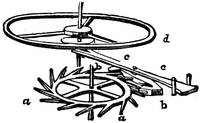 Lever Escapement.
horseback, as these instruments are liable to be affected by any sudden motion. Even the stepping quickly from a vehicle may stop them, and yet the escapement be as perfect as possible. They are only adapted for persons of very quiet habits. Thomas Mudge, in the year 1766, introduced an admirable invention, which, after many alterations and improvements, is now universally known as the 'Patent Detached Lever' escapement, represented by—a athe escapement-wheel, b b the ruby pallets, c the lever, d the balance. On the axis of the balance d, towards the lever c, is a small disc of steel, into which is inserted a small pin made of ruby. This pin fits with great nicety into a notch or opening in the end of the lever c, upon which are firmly fixed the two pallets b b, into which are secured rubies very finely polished. The balance in its vibration on either side, carrying with it the steel disc and ruby pin, causes that pin to enter the notch in the lever and carry the lever with it, and at the same time, to draw the pallet from the tooth of the escapement-wheel a.
Power being exerted upon this wheel by the mainspring, the wheel tooth gets disengaged from the locking-face of the pallet, forces itself down the slopes of the pallet, and thus[ 82] gives impulse to the balance. At each vibration the same unlocking takes place, but as soon as the wheel tooth falls from the slope, the opposite pallet is prepared to receive the advancing tooth of the escapement-wheel, and so on in succession beat after beat takes place. So excellent was this escapement considered a few years back, that chronometers were made upon the principle, and placed in the Royal Observatory for public trial. But since then many improvements have been made in it, so that makers are now enabled to produce a pocket watch, with the short angle lever escapement, which marks time at a steady rate of within four or five seconds weekly,—a rate which approaches so near to the time-keeping of a pocket chronometer, that unless the minutest exactness for some specific purpose is required, the last-named watch is all that can be wished for.